
BIP: Communities in Action 2025
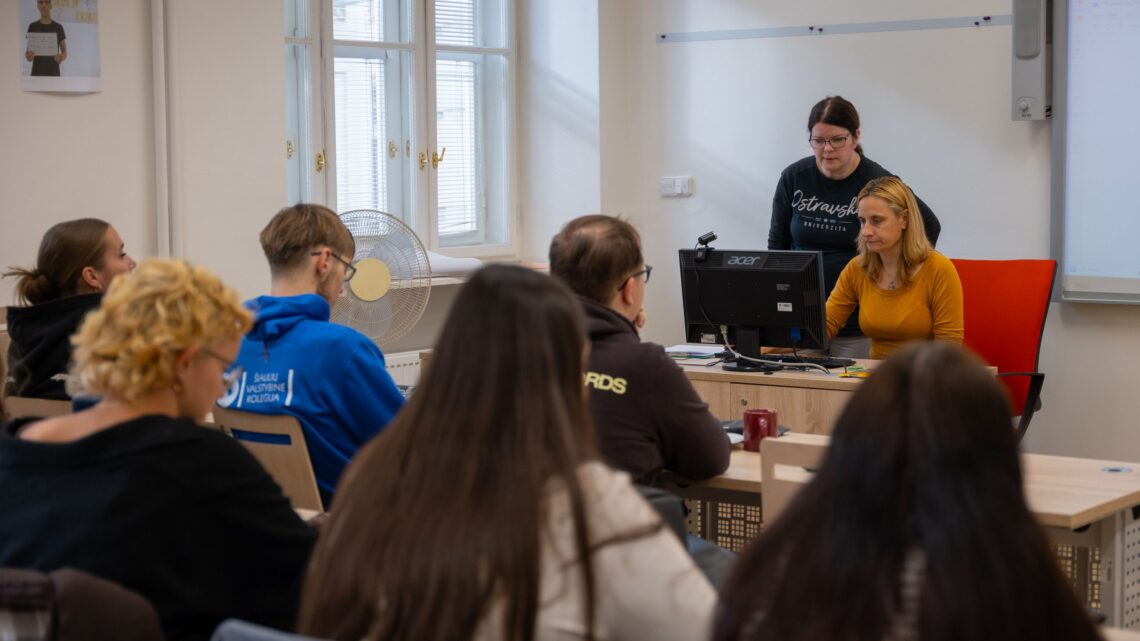
The third year of the BIP program Communities in Action at the Faculty of Social Studies, University of Ostrava, that is organised in collaboration with the U!REKA Lab: Urban Commons, provided an intensive field experience for European students.
Read the translation of the article: https://alive.osu.cz/communities-in-action-2025-treti-rocnik-bip-programu-na-fss-ou-prinesl-intenzivni-terenni-zkusenost/
For the third time this year, the Faculty of Social Studies at the University of Ostrava hosted foreign students as part of the week-long Erasmus+ Blended Intensive Programme (BIP) entitled “Communities in Action: Urban Sustainability & Engagement” under the auspices of the NEOLAiA alliance. Foreign partners included Šiaulių valstybinė kolegija from Lithuania, Frankfurt University of Applied Sciences from Germany, University of Ljubljana from Slovenia, and FHV – Vorarlberg University of Applied Sciences from Austria. Our BIPs have a clearly defined continuity – from theoretical considerations of urban space to direct work in communities.
The year 2025 brought the most practical and intensive edition yet, entitled “Communities in Action,” involving students from Austria, Germany, Slovenia, Lithuania, and the Czech Republic. For the first time, not only social work students but also architecture students came together. This interdisciplinary connection brought new perspectives and opened a discussion on how to combine spatial and social approaches to community work.
Introductory lectures on socially excluded localities were followed by a visit to the Jílová area, where participants had the opportunity to gain insight into the everyday reality of local residents. The students visited a low-threshold center, met with children and young people, and began to think together about how they could bring something valuable to the locality during the week.
On Wednesday, they returned to Jílová with prepared activities. Small work teams were formed, offering children art workshops, sports games, and bracelet making. One of the groups also created a community bulletin board for offers and requests, a simple but functional tool for sharing small favors among residents—from borrowing tools to helping with babysitting. According to feedback from participants, “it was a moment when the barriers between students and residents were naturally broken down.” Another powerful moment of the day was a spontaneous cultural experience—a Roma children’s choir that kicked off the afternoon program. Their singing attracted other residents and created an informal meeting space that went beyond the scope of the planned activity.
Thursday’s part of the program was dedicated to the Bedřiška community, which was included in the program as a contrasting example of community development led by the residents themselves. Ms. Lehocká introduced herself to the students and shared a story about the power of neighborhood, civic engagement, and the right to a home. For many students, it was a fundamental experience—according to one participant, “it was inspiring to see that change can come directly from within the community if there is trust and mutual responsibility.”
The program also included an informal cultural evening – foreign students attended the university hockey derby between Ostrava University and VŠB-TUO, where they experienced the local academic atmosphere.
Friday morning was devoted to the “photovoice” method, during which students processed their experiences in the form of picture collages. Reflections showed that the program had not only an educational but also a strong personal impact. Some participants expressed interest in continuing the work they had started – four architecture students want to return to Jílová next year, and one economics student from Lithuania plans to start cooperation as early as this summer.
This year confirmed that BIP is not just a short-term study program, but a living platform for the meeting of disciplines, cultures, and perspectives that can truly stimulate interest in community work in practice. As one of the reflections put it: “We didn’t go to Jílová just to try something out – we were there with the people, not for them,” says one of the colleagues involved, Kumar Vishwanathan.